
Healthcare facilities must continuously evolve to support advances in medicine, changing patient needs, and increasingly sophisticated technology. For Veterans Affairs medical centers, modernization often presents an additional challenge: delivering major facility upgrades while maintaining uninterrupted patient care.
At the Olin E. Teague Veterans’ Medical Center, OEI was selected to support that mission through the design of a new surgical suite addition and renovation of existing surgical facilities. The project required balancing complex clinical requirements, aging infrastructure, and ongoing hospital operations while creating a modern environment capable of supporting future surgical services.
Table of Contents
Expanding the Surgical Department at Olin E. Teague Veterans' Medical Center While Keeping It Operational
Hospital renovations rarely occur in empty buildings, and this one is no different. One of the project’s most significant challenges was maintaining ongoing surgical operations while designing and delivering a major expansion.
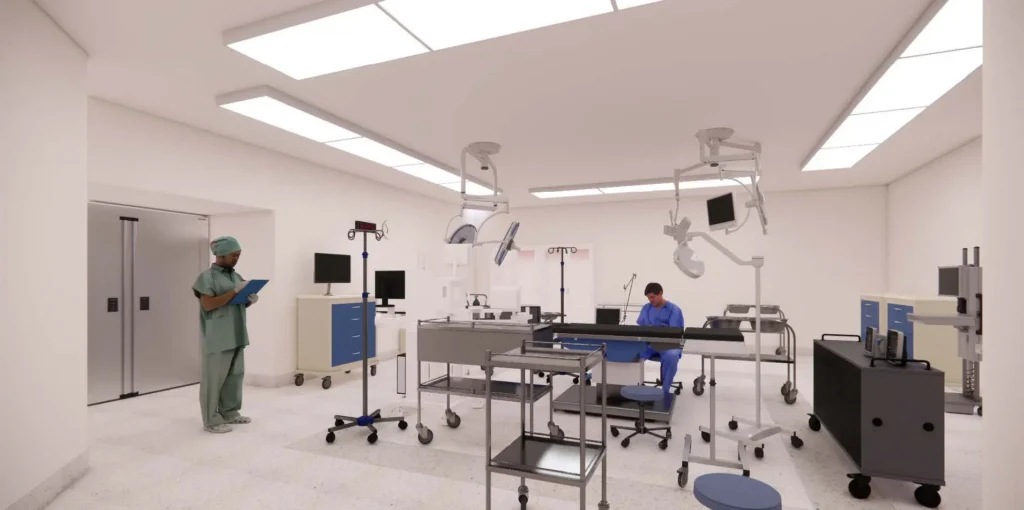
OEI designed ~23,000 square feet of new surgical facilities while renovating adjacent support spaces and upgrading critical infrastructure. Throughout the project, the existing eight operating rooms needed to remain functional, requiring careful phasing and coordination to minimize disruption to patient care.
The completed design included:
- Four new operating rooms, including general, specialty, hybrid, and robotic surgery suites
- New sterile processing support functions
- Medical equipment planning and integration
- Utility and electrical infrastructure upgrades
- Enhanced patient and staff circulation patterns
- Dedicated support, storage, and mechanical spaces
Engineering Beyond the Operating Room
Modern surgical suites are among the most technically demanding spaces within a healthcare facility. Meeting clinical requirements requires far more than architectural planning alone.
At Olin E. Teague Veterans’ Medical Center, the design team coordinated structural, mechanical, electrical, medical equipment, and life-safety systems to support highly specialized surgical environments while complying with current VA design standards.
Several unique design challenges influenced the final solution. Because the existing surgical department operated on the second floor, the new addition was elevated to align with existing floor elevations and maintain efficient clinical workflows. This required a specialized structural system supported on piers while accommodating large operating room spans and substantial equipment loads.
The project also included planning for sterile and soiled processing flows, medical equipment movement, utility upgrades, emergency power requirements, and the integration of mechanical systems needed to support surgical environments.

Experience Supporting Veterans Healthcare Infrastructure
As a Service-Disabled Veteran-Owned Small Business (SDVOSB), OEI has extensive experience supporting Veterans Affairs healthcare facilities through planning, architecture, engineering, and infrastructure modernization projects.
Our work spans medical facilities, utility infrastructure, facility assessments, and mission-critical healthcare environments. Across these projects, our focus remains consistent: delivering technically sound solutions that improve facility performance while supporting the needs of veterans, healthcare providers, and facility operators.
Investing in Facilities That Support Future Care
Healthcare infrastructure investments are ultimately investments in patient outcomes. Modern surgical facilities improve operational efficiency, support advanced medical technologies, and provide healthcare professionals with environments designed for today’s standards of care.
The surgical suite expansion at the Olin E. Teague Veterans’ Medical Center demonstrates how thoughtful planning and multidisciplinary engineering can modernize aging healthcare infrastructure while maintaining continuity of care. OEI is proud to support projects that strengthen VA facilities and improve the environments where veterans receive treatment and care.