
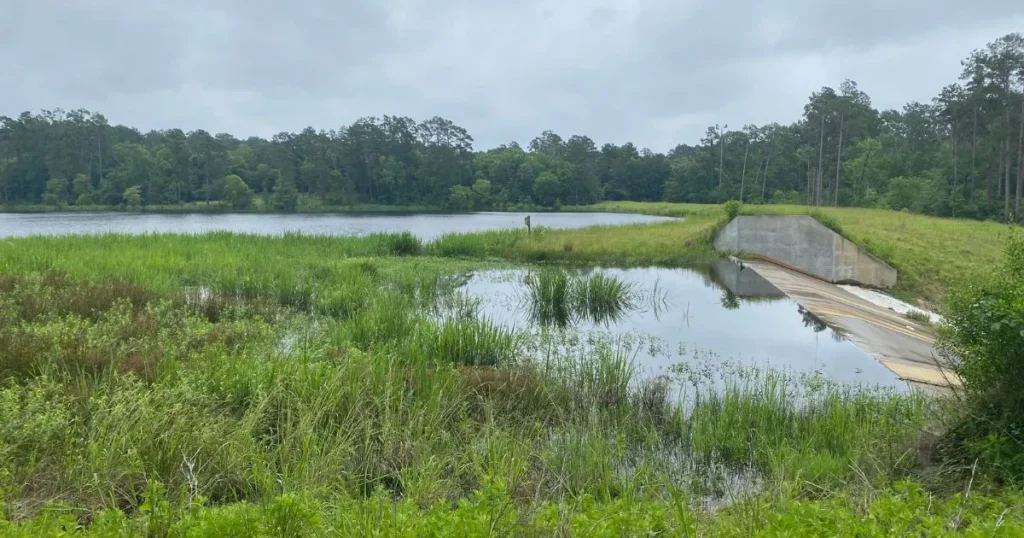
Every infrastructure project, from a new roadway or dam to a military facility renovation or water system upgrade, has an environmental footprint. Understanding that footprint before construction begins is not just good practice – it is a regulatory, legal, and community obligation. Environment studies are the structured, data-driven assessments that make that understanding possible.
For community decision makers, agency officials, and project sponsors, these studies translate raw environmental data into actionable guidance. They identify risks, propose mitigation, and provide the defensible analysis needed to move projects from concept to construction with confidence.
Table of Contents
TL;DR
What Is an Environment Study?
An environment study is a systematic analysis of the potential effects that a proposed infrastructure project or existing facility may have on the surrounding natural and built environment. These studies range in scope from narrowly focused assessments of a single drainage corridor to comprehensive environmental impact statements covering hundreds of acres and multiple regulatory jurisdictions. At its core, every environment study serves two purposes: generating empirical data about current baseline conditions, and modeling how a proposed action will change those conditions.
A thorough environment study draws from five foundational disciplines of environmental science:
- Atmospheric science: Air quality, emissions modeling, climate considerations, and the effects of temperature and precipitation on project outcomes
- Ecology: Assessment of plant and animal communities, wetlands, riparian buffers, and species habitat within and adjacent to the project area
- Environmental chemistry: Analysis of soil and water quality, contaminant pathways, pollutant loading, and chemical interactions in the project environment
- Geoscience: Soil mechanics, geology, groundwater, erosion potential, floodplain dynamics, and subsurface conditions
- Social science: Community impacts, land use, environmental justice considerations, and the human dimension of infrastructure decisions
No single discipline provides a complete picture. The strength of a well-executed environment study is the combination of all five, interpreted by a team that understands how they interact on a specific site under specific project conditions.
The Regulatory Landscape for Environment Studies in 2025 and 2026
The regulatory framework governing environment studies for federally funded or federally permitted infrastructure changed substantially in 2025, with direct implications for how studies are scoped, conducted, and submitted.
What Changed with NEPA in 2025
On February 25, 2025, the Council on Environmental Quality (CEQ) issued an interim final rule rescinding its NEPA implementing regulations, which had governed federal environmental review since 1978. CEQ finalized the rescission on January 8, 2026. Federal agencies are no longer bound by a single government-wide NEPA framework. Each agency now operates under its own NEPA procedures, many of which were updated in July 2025. For project sponsors and their engineering teams, environmental review requirements now vary by agency, and navigating that landscape requires current knowledge of agency-specific rules.
The National Environmental Policy Act (NEPA), signed into law in 1970, remains in force as a federal statute. What changed is how agencies implement it. For decades, CEQ’s uniform rules provided a common process: categorical exclusions for low-impact actions, environmental assessments (EAs) for moderate impacts, and environmental impact statements (EISs) for major actions with potentially significant effects. That structure still exists at the agency level, but it now varies from agency to agency.
Major federal agencies including the U.S. Army Corps of Engineers and the Departments of Defense, Energy, Agriculture, Transportation, and Interior all published updated NEPA implementing procedures effective July 3, 2025. The Supreme Court’s May 2025 decision in Seven County Infrastructure Coalition v. Eagle County further reinforced that agencies have substantial deference in scoping their environmental reviews.
For O’Brien Engineering’s clients in the federal, military, and VA healthcare sectors, these changes underscore why partnering with an A/E firm that actively monitors the regulatory environment is essential. Requirements that were standard in 2024 may now need to be verified against an agency’s updated 2025 procedures before a study scope is finalized.
At the state level, Texas continues to operate its own environmental review and permitting programs independently of CEQ. TCEQ’s stormwater permitting under the Texas Pollutant Discharge Elimination System (TPDES) remains active, including requirements under the TCEQ stormwater program. The 2024 Phase II Small MS4 General Permit (TXR040000) brought updated urban stormwater management requirements for municipalities, and the Multi-Sector General Permit for industrial facilities was revised in 2025 with 2026 renewal now underway.
Types of Environment Studies for Infrastructure Projects
The type of environment study a project requires depends on the nature of the action, the funding and permitting agencies involved, and the environmental sensitivity of the site. Common study types O’Brien Engineering supports include:
- Environmental Impact Statements (EIS): The most comprehensive form of NEPA review, required for major federal actions with potentially significant environmental effects. EISs analyze alternatives, assess direct and indirect impacts, and include a public comment process.
- Environmental Assessments (EA): A focused analysis used when the significance of environmental effects is uncertain. If the EA concludes no significant impact, the agency issues a Finding of No Significant Impact (FONSI).
- Hydrologic and Hydraulic Studies: Critical for water infrastructure, dams, levees, and floodplain development. These studies model how water moves through a watershed and how infrastructure changes affect flood risk, erosion, and water quality.
- Stormwater Pollution Prevention Plans (SWP3): Required under TPDES for construction projects disturbing one acre or more. SWP3s identify pollutant sources and specify best management practices to prevent stormwater contamination.
- Floodplain Studies and FEMA Map Revisions: Engineering analyses that define or redefine flood hazard boundaries, supporting FEMA Letter of Map Revision (LOMR) or Letter of Map Amendment (LOMA) submittals.
- Facility Condition and Environmental Compliance Assessments: Evaluations of existing facilities for environmental deficiencies, code compliance gaps, and deferred maintenance with environmental implications.
Why Engineering Expertise Is Central to Environment Studies
Data collection is only one component of a credible environment study. The interpretation, integration of that data with engineering design, and communication of findings to decision makers is where real value is created, and where errors become costly.
Consider a drainage infrastructure project in a developed urban watershed. An environment study for that project must account for upstream and downstream hydraulic conditions, existing water quality impairments, soil erodibility, potential impacts to jurisdictional wetlands, and the stormwater regulatory requirements of both the project site and the surrounding drainage system. None of these can be evaluated in isolation. The engineer preparing the study must understand how they interact, how proposed design elements will change those interactions, and how to document that analysis in a form that satisfies the relevant regulatory agencies.
Civil and environmental engineers must also anticipate secondary effects. Channelizing a creek to reduce flooding in one neighborhood can accelerate erosion downstream. A rigorous environment study models these effects in advance and proposes design modifications that prevent them. This is the difference between a study that simply satisfies a permit requirement and one that genuinely supports better infrastructure outcomes.
Environment Studies from O'Brien Engineering: Multidisciplinary, Mission-Driven
O’Brien Engineering’s multidisciplinary team of civil, environmental, and MEP engineers brings an integrated approach to environment studies that reflects the complexity of real infrastructure projects. Our experience spans federal military installations, VA medical campuses, municipal water systems, dam and levee infrastructure, and urban drainage systems across Texas and beyond.
O’Brien Engineering’s environment study services include:
- Hydrologic and hydraulic modeling for drainage, dam, and water system projects
- Floodplain analysis and FEMA LOMC preparation, with over 1,000 submittals and a 100 percent approval rate
- Stormwater master planning, SWP3 preparation, and TPDES permit compliance
- Environmental permitting coordination with TCEQ, USACE, FEMA, and state agencies
- Erosion control design and streambank stabilization studies
- Watershed and surface water restoration assessments
- Environmental compliance components of facility condition assessments
Every man-made piece of infrastructure changes the environment around it. The goal of a well-executed environment study is to understand that change before construction begins, design to minimize negative effects, and deliver infrastructure that serves communities for generations without imposing unsustainable costs on the natural systems it depends on.
Explore O’Brien Engineering’s Water Resources capabilities and Dam and Levee Safety services to see how our environment study expertise supports infrastructure projects of every scale. Contact O’Brien Engineering today to discuss the environmental study needs for your next project.