
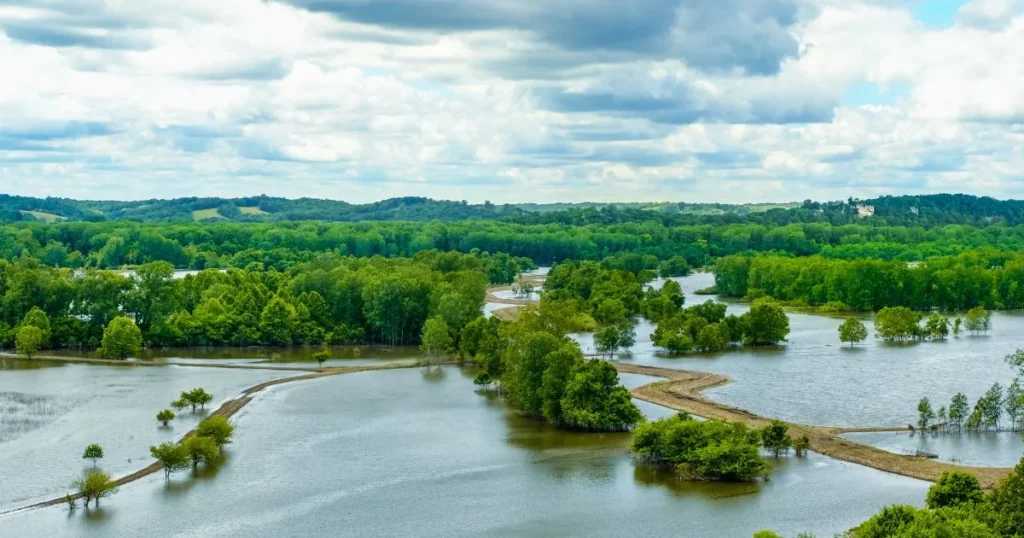
Dam and levee safety influences how communities plan, develop, and protect land in flood-prone areas. As infrastructure ages and development increases, watersheds continue to change. Understanding how these structures perform under evolving water conditions—and how they influence floodplain risk—is essential to protecting lives, property, and public resources.
Table of Contents
Floodplain risk analysis helps engineers and planners evaluate how dams and levees respond to extreme events and how potential failures could affect downstream areas. When done proactively, this analysis supports safer infrastructure decisions and long-term community resilience.
What is floodplain risk analysis?
Floodplain risk analysis evaluates how water moves across a watershed and how dams and levees perform under stress. It focuses on both the likelihood of failure and the consequences of failure, consistent with FEMA-developed federal dam safety guidelines.
This analysis considers factors such as:
- Extreme rainfall and flood events
- Hydraulic and structural loading
- Seismic activity, where applicable
- Downstream land use and development
- Potential impacts to people, infrastructure, and ecosystems
Rather than evaluating structures in isolation, risk analysis looks at how engineered systems interact with the surrounding environment over time.
Why floodplain and infrastructure conditions matter for dam and levee safety
Flood risk is not static. Changes upstream or within a watershed can significantly alter water behavior and increase stress on existing structures. When these conditions evolve, dams and levees designed under older assumptions may no longer provide the intended level of protection. Incorporating current floodplain conditions into safety evaluations allows engineers to anticipate vulnerabilities before failures occur.
Common drivers of increased risk include:
- Urban and infrastructure development that increases runoff
- Reduced natural infiltration
- Shifts in rainfall intensity and storm duration
- Expansion of development into areas historically prone to inundation
How engineers evaluate dam and levee risk
Modern dam and levee safety evaluations follow a structured, risk-informed process consistent with the risk-informed dam safety framework supported by the Association of State Dam Safety Officials (ASDSO) and federal agencies.
This approach aligns with the U.S. Army Corps of Engineers Levee Safety Program, which establishes national standards for evaluating levee performance, operational reliability, and downstream risk.
Key evaluation areas include:
- Loading conditions: Flood and seismic forces that stress the structure during extreme events
- Structural performance: Embankments, foundations, concrete elements, and hydraulic systems evaluated for erosion, instability, seepage, overtopping, and material deterioration
- Operational and mechanical systems: Gates and control systems reviewed for reliability and failure probability
- Downstream consequences: Potential impacts to life safety, property, critical infrastructure, and environmental resources
This approach allows engineers to prioritize rehabilitation or retrofit efforts based on measurable risk rather than prescriptive checklists alone.
Connecting risk analysis to floodplain planning
Dam and levee safety directly influences land use and floodplain planning decisions. Structures that once met design standards may not provide adequate protection as development patterns and hydrologic conditions evolve.
Risk-informed planning supports:
- Updated flood mitigation strategies
- Better land use decisions near regulated structures
- Emergency action planning
- Long-term capital improvement planning
By integrating structural analysis with floodplain considerations, communities can reduce exposure while supporting responsible growth.
Experience that supports resilient water infrastructure
OEI brings nearly 40 years of experience supporting dam and levee safety evaluations, flood risk analysis, and flood mitigation planning. We work with communities and agencies to interpret complex hydraulic and hydrologic data and apply current regulatory guidance to real-world conditions.
OEI services include:
- Dam and levee safety evaluations
- Floodplain risk analysis
- Rehabilitation and retrofit design support
- Regulatory coordination
- Flood mitigation planning
With extensive experience working alongside federal and local agencies, OEI delivers defensible solutions that balance safety, compliance, and long-term infrastructure performance.
Plan before risk becomes a crisis
Flood risks evolve gradually, but failures often occur suddenly. Proactive evaluation and planning help communities address vulnerabilities before they become costly or dangerous.
If your community is facing aging infrastructure, changing water conditions, or increased development pressure, now is the time to assess dam and levee safety within the broader floodplain context.
Contact O’Brien Engineering to discuss practical, risk-informed solutions that support safer water infrastructure and long-term resilience.