
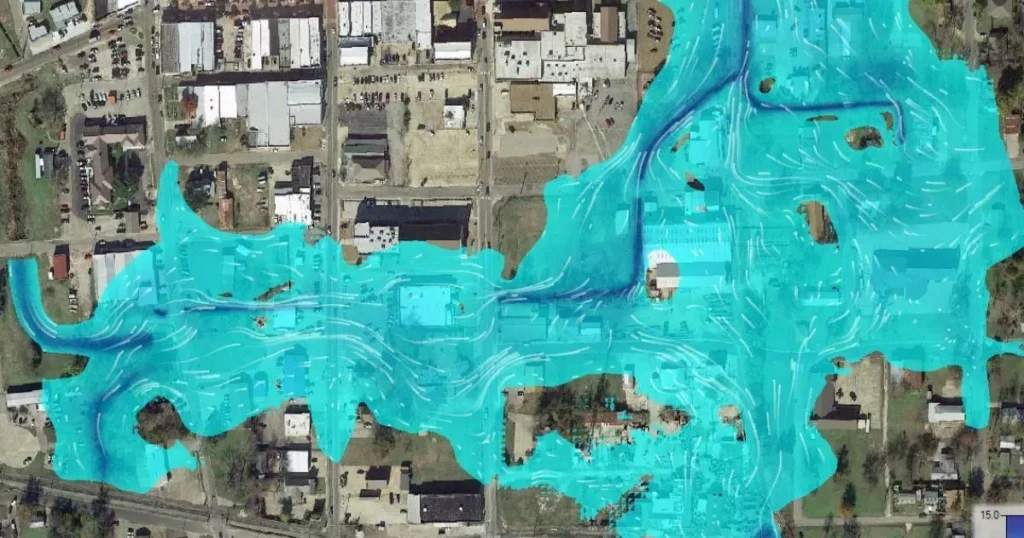
Flooding isn’t just a coastal or riverine issue anymore; it’s a national one. Across the U.S., more frequent extreme rainfall, aging infrastructure, and continued development are reshaping flood risk in ways that are increasingly difficult to predict and manage. Communities that were once considered “low risk” are now experiencing recurring flooding.
That shift is changing how FEMA and the broader engineering community approach floodplain management. At the center of that shift are Certified Floodplain Managers (CFMs).
Table of Contents
Flood Risk Is a Systems Problem
Flooding has traditionally been addressed as a localized issue: a drainage problem here, a channel improvement there.
But as OEI’s water resources work continues to show, flood risk is rarely isolated. It is the result of interconnected systems, watersheds, infrastructure, development patterns, and climate conditions working together (or sometimes against each other).
CFMs play a critical role in understanding those connections. They don’t just enforce regulations; they help translate complex hydrology, infrastructure performance, and federal policy into practical, buildable solutions.
What Does a Certified Floodplain Manager Actually Do?
At its core, a CFM is a technical specialist with expertise in:
- Hydrologic and hydraulic (H&H) modeling
- FEMA and National Flood Insurance Program (NFIP) requirements
- Flood risk assessment and mitigation planning
But in practice, the role is broader.
CFMs often serve as a bridge among engineering design, regulatory frameworks, and funding strategies, helping communities make informed decisions about where and how to invest in resilience.
Where CFMs Make the Biggest Impact: FEMA Grants
FEMA grant programs such as BRIC, FMA, and HMGP are critical tools for communities seeking to reduce flood risk.
But securing those funds is highly competitive and heavily data-driven. This is where CFMs add real value. They help shape projects so they are not only technically sound but also aligned with FEMA’s evaluation criteria.
That includes:
- Technical validation: CFMs review hydrologic models and drainage designs to confirm that proposed solutions will perform under real-world conditions.
- Cost-benefit alignment: FEMA funding depends on measurable risk reduction. CFMs quantify potential damages avoided, helping justify project investment.
- Prioritization of risk: Not all flooding problems are equal. CFMs help communities focus on areas with the greatest exposure, whether that’s critical infrastructure, repetitive loss properties, or high-growth corridors.
In short, they help turn a good idea into a fundable project.
After the Storm: Rapid, Data-Driven Assessments
CFMs also play a key role after flood events. When disasters occur, FEMA relies on accurate, timely field data to determine the scale of response and recovery funding.
CFMs support that process by:
- Documenting high water marks
- Evaluating structural and infrastructure damage
- Estimating economic impacts
Their assessments help shape everything from disaster declarations to recovery funding priorities, making accuracy and speed critical.
Why Flood Mapping Still Matters (More Than Ever)
One of the most common issues CFMs encounter is outdated flood mapping.
Many communities are still relying on older Flood Insurance Rate Maps (FIRMs) that don’t reflect:
- New development
- Changed drainage patterns
- Updated rainfall data
CFMs work with FEMA and local agencies to modernize these maps using:
- GIS-based analysis
- Updated hydrologic and hydraulic modeling
- Current topographic and land use data
Better maps don’t just improve compliance; they improve decision-making.
They help communities:
- Plan smarter infrastructure investments
- Make more informed zoning decisions
- Provide more accurate insurance guidance to property owners
Beyond Compliance: The Technical Value CFMs Bring
CFMs are sometimes still seen as regulatory specialists, but their role in engineering projects is much more technical.
They contribute directly to project performance through:
- Hydraulic modeling and analysis
Evaluating system behavior during extreme events and identifying design gaps - Permitting and coordination
Aligning federal, state, and local requirements early to avoid redesigns and delays - Stormwater and watershed strategies
Supporting integrated solutions that address both water quantity and quality - Infrastructure evaluation
Assessing risks across drainage systems, floodplains, dams, and levees
This aligns closely with OEI’s broader approach to water resources: solutions that integrate analysis, design, and long-term performance.
Why Bringing Certified Floodplain Managers In Early Changes Outcomes
Communities that engage CFMs early in the planning process tend to see clearer, more measurable benefits, not because of compliance, but because of coordination.
Early CFM involvement helps:
- Strengthen FEMA grant competitiveness
- Reduce lifecycle costs through proactive design
- Avoid regulatory delays during permitting
- Improve long-term flood resilience
It shifts projects from reactive fixes to strategic investments.
The OEI Perspective
At OEI, floodplain management isn’t a standalone service. It’s part of a larger, integrated water resources approach.
Our Certified Floodplain Managers work alongside engineers, modelers, and designers to:
- Support FEMA grant development and review
- Conduct post-disaster damage assessments
- Modernize flood mapping and modeling
- Integrate flood mitigation into broader infrastructure design
That multidisciplinary coordination is what allows projects to move more efficiently, from planning to funding to implementation.
Floodplain management is evolving. It’s no longer just about identifying risk; it’s about managing it across systems, funding, infrastructure, and long-term community growth. Certified Floodplain Managers sit right at that intersection.
And as flood risk continues to expand, their role will only become more critical, not just to FEMA, but to every community working to build a more resilient future.